Essential networking tips

for small business

Android KitKat Unveiled

Suprising move by Google

Windows 8

Nine unanswered questions about the new OS

Pioneer 15x Blu-ray burner

coming soon for under $100

Thursday, April 18, 2013

Who’s Winning, iOS or Android? All the Numbers, All in One Place


Phil Schiller and J.K Shin

Bloomberg / Getty Images
 
Left, Apple marketing chief Phil Schiller introduces the iPhone 5 on Sept. 12, 2012. Samsung CEO J.K. Shin brandishes two Galaxy S4 phones at the product launch on March 14, 2013
Who’s winning the mobile platform wars, Apple’s iOS or Google’s Android?

It’s one of the blogosphere’s favorite tech topics. Every new nugget of competitive information is fodder for an avalanche of coverage. Oftentimes, a story will declare that Android is beating iOS or that iOS is beating Android.

Really, though, it’s silly to obsess over any one data point. If what you’re after is a clear idea of how the world’s two dominant mobile operating systems are doing — rather than an excuse to make bold proclamations and/or cheer for your favorite — you want to consider lots of data points.

So that’s what I’m doing in this post. I’ve rustled up results from a bunch of studies, focusing on information that’s relatively fresh. (In some cases, it dates from the fourth quarter of 2012 — stats for the first quarter of this year are still scarce.)

A few notes on this exercise:

I’m not really going to look at changes over time. Trajectories are important, but there’s a limit to how much I can do in one story.

I won’t do deep analysis of why the numbers look the way they do. I’m collecting rather than interpreting, though I hope that some of you will draw conclusions in the comments.

I’m not going to include specific numbers for anything other than iOS and Android. Sorry, Windows Phone and BlackBerry — I’ll come back to you and how you’re doing at some point, I promise.

I won’t include forecasts and other predictions. I don’t believe in ‘em.

I’m not endorsing any of these studies. That’s dangerous unless you have a thorough knowledge of the methodology behind the numbers. Which I don’t.

Without any further ado, here are some key competitive questions, and the answers as provided by various research firms.

Which platform is selling the most smartphones?

In research conducted from mid-November through mid-February, Kantar Worldpanel Comtech showed sales of all Android phones outpacing the iPhone by a hefty margin: 52.1 percent to 43.5 percent. However, judging from past Kantar studies, these figures may be more of a freeze-frame of the competition at one particular point in time than a permanent reality: last year, Kantar had Android in the lead for a spell, and then it said that iOS had bounced back into first place.

Then there’s Comscore’s MobiLens study, which attempts to measure the smartphone platforms used by everyone in the U.S. over the age of 13 —  not just ones sold recently, but everything. The numbers it released this month are pretty similar to Kantar’s.

That’s the U.S. — how about everywhere else?

Worldwide, all those companies making Android phones sell a lot more units than Apple sells of the iPhone, says IDC. In the fourth quarter of 2012, Android had more than 70 percent share, vs. 21 percent for the iPhone.

And tablets?

Tablet shipment data is harder to come by than data for phones, and the most recent specific numbers by platform I could find were IDC’s full-year estimates for 2012, which it released on December 5 of last year. They had demand for 7″ Android tablets adding up to a decrease in the iPad’s dominance — but iOS still remained the most popular tablet operating system.

Which companies are selling the most smartphones?

Worldwide, according to IDC, Samsung — which deals primarily, but not exclusively in Android models — was the top manufacturer in the fourth quarter of last year, unit-wise. Apple was in second place.

In the U.S., however, Strategy Analytics says that Apple’s iPhone shipments outpaced Samsung. (Strategy Analytics says that its numbers are for “mobile phones,” so they may include plain ol’ flip phones as well as smartphones.)

Who’s making money selling smartphones?

As you might guess from the above two charts, Apple and Samsung are the ones raking in the bucks, says Canaccord Genuity. And Apple is raking in far more of them than Samsung, taking 72 percent of the profit in the last quarter of 2012. Samsung made 29 percent of the industry’s profit — mostly for Android phones, although it also has Windows Phone handsets. Everybody else in the business, including Android-centric makers such as HTC and Motorola, either broke even or lost money — which is why Apple and Samsung’s profits add up to more than 100 percent.

genuity

Which platform has the most apps?

After years of obsessing over the sheer quantity of apps available for these two platforms, the numbers seem to be similar, and similarly impressive, on both sides. Both Apple and Google currently claim more than 800,000 third-party programs for their respective platform.
apps

What do the numbers look like for tablet-specific apps?

For iOS, Apple says there are more than 300,000 iPad-optimized programs. For Android: I wish I knew! As far as I know, Google hasn’t disclosed this number. But it’s safe to say that it remains piddling compared to Apple’s figure.

O.K., who has the best apps?

I hesitate to bring this up, because app quality is inherently subjective. But a company called uTest uses a system called Applause to crawl Apple’s App Store and Google’s Google Play, collecting user reviews and rankings. It then turns this data into scores from 1 to 100 for individual apps, and calculates average scores for each platform. In data published in a ReadWrite story in January, it said that the average iOS app, with a score of 68.5, is superior to the average Android app, at 63.3.
utest

Which platform’s users are downloading the most apps?

According to Canalys, just over half of all apps downloaded in the first quarter of this year were for Android. iOS, at about 40 percent share, was the only other big-time player.

Who’s making money from app downloads?

According to Canalys’s data for the first quarter of this year, iOS users are spending much more on apps even if they’re downloading fewer of them overall.

Which platform gets used most on the Internet?

NetMarketShare publishes monthly stats on which browsers and operating systems are being used on the Net. Its report for March 2013 says that among mobile devices, iOS rules with 60.1 percent share. Android is way behind at 24.9 percent. Given that there are more Android devices out there, the data suggests that iOS users are disproportionately active online.
But here’s something weird: StatCounter, which does a similar study, comes up with numbers that are nothing like NetMarketShare’s. Its figures for March show Android usage easily outpacing iOS. Of course, the two organizations’ methodology may be radically different; I’m not sure, for instance, whether both, either or neither of them include the iPad in these numbers. But the disparity is a healthy reminder that it’s risky to draw conclusions from data you don’t know very much about.

Which platform is more widely used in business, iOS or Android?

A Citrix report covering the fourth quarter of 2012 comes as close to addressing this question as any recent study I’ve seen. It covers Citrix customers that “have deployed enterprise mobility management in the cloud,” and shows iOS as trouncing Android and everything else.

So who is winning — iOS or Android?

You had to ask, huh?

On some level, it’s too crude a question to take very seriously. There are just too many ways to define “winning,” and neither platform leads in every area. But here’s the closest thing to an objective answer I can manage.

“Android if you’re talking about market share; iOS if you mean financial success. So far, this is a strikingly different market than the PC business back in the 1990s, when market share translated directly into financial success.”

You, of course, are entitled to come to a different conclusion — and if you do, I hope you’ll share it in the comments.

Source

Glass Explorer Edition gets unboxed, photographed (video)


We already know what Page and Co. will be packing along with Glass, but now that participants of the Explorer program have begun picking up the wearable hardware, we're getting a second-hand unboxing experience. For those in need of a refresher, the glasses will be accompanied by a microUSB cable and charger, a pouch and an attachable shade and clear lens. Though there isn't much to glean from the stream of images, one of Mountain View's adventurers noticed that users will be able to send navigation directions straight from a smartphone to the eyewear. Click the source links below to take a gander at the photos, or hit the jump to watch a video shot with Glass by a Googler.

Update 1: We've slotted in a video after the break of Glass user Dan McLaughlin extracting his device from its packaging. The footage is a bit choppy, but it certainly provides a closer look at the hardware.

Update 2: The intrepid folks at Tinhte managed to get their mitts on Google's headgear and have given us a tour -- albeit in Vietnamese -- of the contraption, replete with close-ups and solid video quality. Head past the break to watch the footage.


Sources - Youtube and Engadget

Monday, March 25, 2013

Major Windows 8 built-in app updates due Tuesday, Google Calendar sync will be disabled

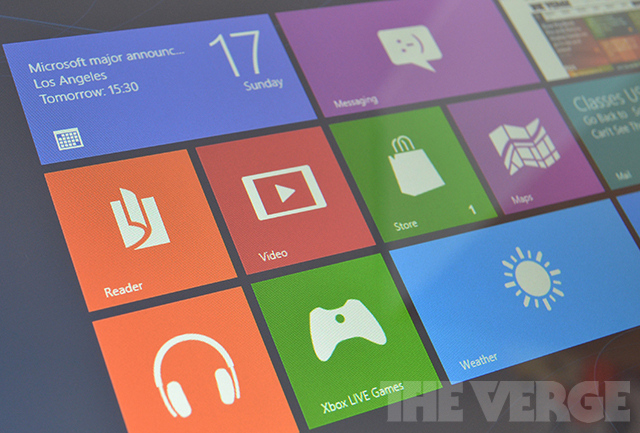
Microsoft major event 
 
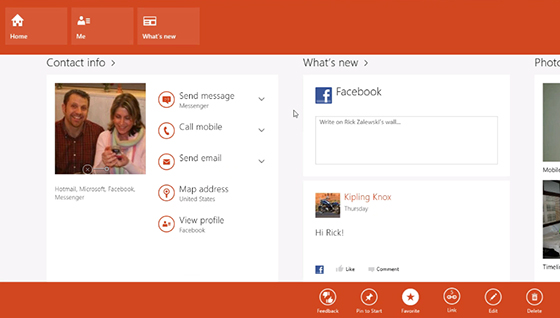
Microsoft is preparing some major updates to its built-in Windows 8 applications on Tuesday. The company is refreshing its communication apps: mail, calendar, and people. In our review of Windows 8 we found that the new built-in apps were significantly lacking functionality, and the performance of them on the Surface RT tablet was poor. Microsoft is attempting to address both of these issues this week.

Mail

The focus is really on mail with this round of updates. Speaking with The Verge, Windows user experience program manager Kip Knox explained that Microsoft recognises the importance of mail, calendaring, and contacts. "Since we shipped Windows 8 we've been working hard on this update," he reveals. The update includes some features and functionality that really should have been part of the original release, but at least Microsoft is starting to correct that. Folder creation, deletion, and renaming is now supported, alongside a filter that brings up unread messages.

Mail

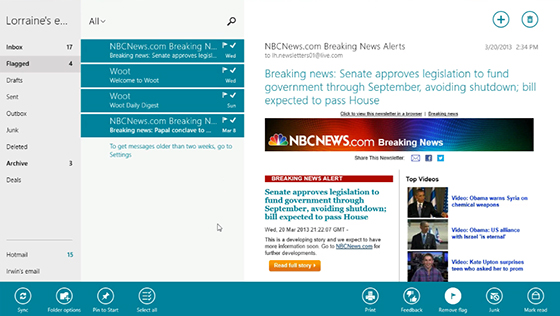
Mail should sync a lot faster and more reliably says Knox, with a new feature to let users to mark mail as spam. With Gmail this will move the message to the spam folder, but with Outlook.com it will do the same and also alert Microsoft's spam filter about the mail to ensure a similar one isn't placed in the inbox in future. Flagging is now supported too, with a filter to view all flagged messages. One of the bigger improvements is search. You can now search all mail on the server, which brings up results regardless of the amount of email you have synced with your device.

Mail finally gets decent draft support and speed improvements

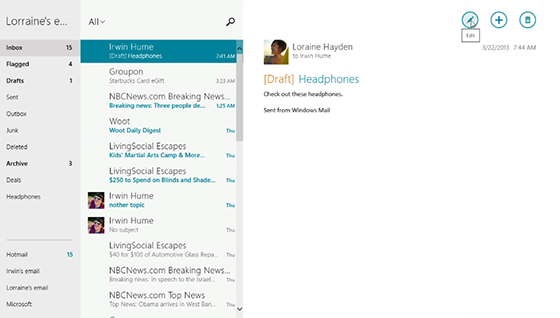
Microsoft has also improved the compose messages part of mail. Surface RT users will be able to create messages a lot quicker, and the mail client will now automatically provide contact suggestions based on the number of times you email certain people. Draft messages has also been greatly improved. When you back out of an email message, mail will automatically save a draft and show it inline with the rest of your messages. There's no way to turn this behaviour off, but you can go through the drafts folder to delete individual drafts. You'll also be able to paste in formatted charts a lot more reliably, and edit bulleted or numbered lists more easily. Adding, editing, and deleting hyperlinks is now supported too.

Mail_drafts

Other minor improvements include the ability to delete all messages in a folder or mark them as read, an option to save senders as new contacts, and support to send email from an Outlook.com alias. Microsoft is also building in information rights management email support for business users, allowing them to securely send email attachments and read encrypted ones.

Calendar

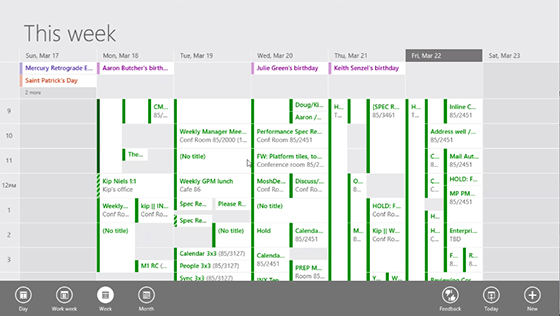
On the calendar side, Microsoft has made some tweaks to the UI to improve readability. Font sizes and colors have been improved, and a new work week view lets you focus on Monday to Friday to find appointments. Calendar now includes the current time in day and week view that's displayed inline against your appointments. You can also forward meeting invitations and check the availability of attendees. Recurrence options for meetings have also been improved, with the ability to set end dates for recurring events.

Calendar

Microsoft is removing Google Calendar support

One major change in calendar is the removal of Google sync support. "As of this update we will switch all Gmail accounts over to IMAP, we have to," says Knox. Microsoft currently supports Exchange ActiveSync for Google accounts in mail, calendar, and people, but Google has dropped this support for new devices. The app update will remove calendar support for Google, but Windows 8 users will still be able to add Gmail contacts to the people hub. Knox refused to comment on any plans for CalDAV support, which Windows Phone will soon support, so it looks like Windows 8 users will be left out in the cold if they want Google Calendar support natively in Windows 8. It's a disappointing result for users, regardless if you blame Google for the support removal or Microsoft for not implementing CalDAV and CardDAV support sooner.

People

The people app isn't getting any significant improvements with this round of updates, but Microsoft is taking the opportunity to tweak some parts. A new filter will let you control the content of the "what's new feed" by picking social networks, and navigation has been improved with clearer options when the app bar is enabled. A new change on the Facebook integration side lets you post directly to a friend's wall, handy if you use the app for Facebook at all. Finally, Microsoft is also building in support for its Active Directory Global Address List (GAL) for business users.

People
Solid improvements, but still more required

Overall the changes are major for mail users, with a host of improvements and performance enhancements that make the app a lot more usable. Although Messenger is part of the core communications apps, Microsoft isn't updating this app at all. It's unclear how the company plans to manage its Skype and Messenger merger, but given the Messenger app seems redundant now we'd expect it to disappear in time. Skype now supports Messenger conversations and having two apps support identical scenarios seems confusing and unnecessary.

However, Microsoft refuses to comment on its plans for the Windows 8 Messenger app. The built-in Windows 8 apps will all be available in the Windows Store by Tuesday, but If Google Calendar support is essential to you then you might want to hold off updating. The unclear CalDAV support situation leaves users in limbo, so Microsoft needs to reveal its plans before people are left with questions. Despite this, the mail improvements are significant enough make an update worthwhile, and we're hopeful that Microsoft will continue to improve the rest of its apps very soon.

Thursday, March 14, 2013

Microsoft blames overheating datacenter for 16-hour Outlook outage

Microsoft's outlook.com webmail service suffered 16-hour long issues yesterday after a firmware upgrade at the company's datacenter went wrong. In a blog post detailing the outage, Microsoft reveals some customers couldn't access parts of SkyDrive, Hotmail, and Outlook. Although Microsoft has updated its datacenter firmware successfully previously, the regular process "resulted in a rapid and substantial temperature spike in the datacenter" due to an unspecified reason. The overheating was significant enough to activate Microsoft's safeguard process for a number of servers in the datacenter, preventing access to certain mailboxes.

A 16-hour outage is unusual for such a high scale web service, and Microsoft admits it required some human intervention to bring the services back online, thus delaying the restoration attempt.

"Requiring this kind of human intervention is not the norm for our services and added significant time to the restoration," says Microsoft's Arthur de Haan. The company doesn't provide numbers for the amount of users affected, but during the outage period we found that the majority of our own mailboxes were unaffected.

Microsoft is in the middle of transitioning its Hotmail user base over to its new Outlook service. The company has suffered a number of outages since the start of the year, also impacting its Office 365 business service. With three significant outages over the course of 2013, Microsoft promises that it's "hard at work on ensuring this doesn't happen again." At a time when it's investing millions of dollars to market Outlook.com, the company can ill afford to suffer long periods of outages, especially when it's on the attack.

 Source

Wednesday, March 6, 2013

Intel Capital makes a big bet on Android with investment in Bluestacks

Add Intel Capital to the growing list of companies eager to work with Bluestacks.

Intel has invested an undisclosed amount in the startup, BlueStacks told VentureBeat today.

BlueStacks “LayerCake” technology runs Android apps on any Windows PC and Mac, bridging a gap between mobile and the desktop that neither Google or Apple have tackled yet.

Primarily, Intel wants to make sure that BlueStacks’ software is optimized for its chips. The investment could also be a major help for Intel’s smartphones, like the Europe-only Motorola Razr i, which run its x86-based mobile processors instead of the ARM-based processors that power most other Android phones. Intel claims its mobile chips can run 95 percent of Android apps due to the chip architecture difference with its phones.

“Intel has an extremely powerful PC ecosystem, and they are looking to move into mobile in a big way,” said John Gargiulo, the vice president of marketing and business development at Bluestacks in an interview with VentureBeat. “There are more and more Intel chips on Android phones, so I think the alignment is clear.”

Intel just recently announced a new dual-core Atom mobile processor, but it’s at a severe disadvantage since it only started focusing on mobile chips a few years ago. Meanwhile, competitors like Qualcomm, Samsung, and Nvidia have had years to hone their mobile chips.

BlueStacks forged a deal with AMD to power its AppZone back in September, so Intel likely felt the need to step up its relationship. The news also comes on the heels of BlueStacks’ largest deal yet with Lenovo, a similar partnership with Asus, and the launch of a Surface Pro-optmized app.

“Consumers expect to have similar experiences across all devices, and that includes having access to the same popular apps,” Dave Flanagan, a managing director at Intel Capital, said in a statement. “Bluestacks technology is a key catalyst for us in enabling mobile apps to run on any type of device.”
Intel also relies on Bluestacks for its AppUp app store. Twenty-three apps on AppUp, like the popular news reader Pulse and Talking Tom, are listed as coming “via BlueStack Systems,” according to a Google site search. BlueStacks’ client powers those apps when you download them to your PC. It’s a particularly helpful partnership for Intel, since it brings popular apps to its fairly barren app store.
The Campbell, Calif.-based BlueStacks has also raised $15 million so far from Andreessen Horowitz, Ignition Venture Management, Citrix Systems, and others.

 Source

Microsoft restores transfer rights for retail Office 2013 copies

Summary: As part of its shift to a subscription model, Microsoft introduced a controversial "no transfer" restriction with Office 2013. Now, after an intense outcry from customers, the company has reversed course and agreed to allow users to transfer retail Office licenses between devices.

Office 2013 might be brand new, but its license agreement is already getting a significant upgrade. The new language represents a welcome change for buyers who prefer traditional licenses that don't require ongoing payments.

Bowing to “feedback from its customers,” Microsoft is changing the terms of the license agreement for the three retail “perpetual license” versions of Office 2013, restoring the terms that had been present in the corresponding agreement for Office 2010.
See also:
The company announced the changes in a formal statement and in a post on the Office blog.
Based on customer feedback we have changed the Office 2013 retail license agreement to allow customers to move the software from one computer to another. This means customers can transfer Office 2013 to a different computer if their device fails or they get a new one. Previously, customers could only transfer their Office 2013 software to a new device if their PC failed under warranty.
While the licensing agreement text accompanying Office 2013 software will be updated in future releases, this change is effective immediately and applies to Office Home and Student 2013, Office Home and Business 2013, Office Professional 2013 and the standalone Office 2013 applications. With this change, customers can move the software to another computer once every 90 days. These terms are identical to those found in the Office 2010 software.
If you purchase and install a retail copy of Office Home and Student 2013, Office Home and Business 2013, or Office Professional 2013, you will be able to transfer the license from one PC to another. As with previous Office versions, the new terms say you can make this sort of transfer no more than once every 90 days. The license allows only a single installation: the original copy must be uninstalled from the first device before activating it on the second computer. The license terms for OEM copies of Office that are purchased with a new PC remain unchanged; OEM copies cannot be transferred except with the PC itself.

In the original agreement for “perpetual license” versions of the new Office, Microsoft had specifically prohibited licensees from transferring the software, using unambiguous language: "You may not transfer the software to another computer or user."
office-2013-transfer
That policy raised howls of protests from would-be Office buyers wondering what would happen if their computer failed. In a first attempt at damage control, on February 19, Microsoft took to its corporate blog, adding a footnote to a comparison chart that said: “An exception [to the no-transfer rule] is granted when the software is on a PC that is replaced under warranty.”

As I noted at the time, that attempt at placating customers fell short. And apparently someone at a senior level in the Office team was listening, because today’s announcement is a complete rollback of that controversial set of terms. Technically, in fact, the new terms for Office 2013 are looser than those that applied to Office 2010, because the new Office will be available to retail buyers only via Product Key Cards (PKCs). In Office 2010, the PKC license contained a no-transfer clause.
The new terms read, in part:
Can I transfer the software to another computer or user? You may transfer the software to another computer that belongs to you, but not more than one time every 90 days (except due to hardware failure, in which case you may transfer sooner). If you transfer the software to another computer, that other computer becomes the "licensed computer."
(It’s also worth noting that anyone who wants the freedom to use Office on multiple devices should really consider one of the Office 365 subscription editions, which include the rights to install the software on up to five PCs or Macs, with a one-click deactivation process and no pesky 90-day limit.)
By the way, if all this seems familiar, it’s not your imagination. Microsoft tried a similar tactic with Windows Vista in October 2006. The original license agreement imposed a new limit of one transfer on retail copies of Windows. At the time, I called it “a sneaky change in Windows licensing terms.” After a similar outcry from Microsoft customers (a Microsoft executive acknowledged having received "lots of e-mail and other feedback" on this issue), Microsoft rolled back the changes and restored the original license terms less than a month later.

Although the change is effective immediately, the changes in the license agreement itself won’t be published immediately. (It takes several months for those sorts of legal changes to roll out.) It will also take a few months for the public activation servers to reflect the new policy, which means until then anyone who wants to transfer an Office 2013 license, regardless of the reason, will need to call customer support to make the change.

Microsoft’s Jevon Fark, a senior marketing manager on the Office team, tells me that those customer support agents are “ready and onboard, and the back-end activation system will be ready for them.”
I heard from dozens of potential customers who were put off by these terms initially. It will be interesting to see how many of them change their minds and decide to upgrade after all.

Source
By

Tuesday, February 19, 2013

Security firm releases screen capture video of alleged Chinese military hackers at work

Security firm Mandiant has released a damning report offering unprecedented evidence, including screen capture video, of the actions of an alleged Chinese military-backed hacking group.

The report, titled “APT1: Exposing One of China’s Cyber Espionage Units“, tracks the cyber espionage group dubbed Advanced Persistent Threat 1 as far back as 2006.

“Our analysis has led us to conclude that APT1 is likely government-sponsored and one of the most persistent of China’s cyber threat actors,” Mandiant wrote.


More specifically, the group is believed to be the 2nd Bureau of the People’s Liberation Army (PLA) General Staff Department’s (GSD) 3rd Department, also known as Unit 61398.

Appendices attached to the report include thousands of indicators of APT1′s methods, including domain names and IP addresses.

Working off an advance copy of the report, The New York Times followed the trail to buildings in Shanghai believed to house the unit. When the Times encountered persistent attacks from Chinese hackers last year, it worked with Mandiant to monitor and block the intrusions.

While Chinese officials have dismissed the claims of state-sponsored hacking as “groundless”, numerous media organizations, including Bloomberg and The Wall Street Journal, and companies have come forward to state that they faced similar attacks.

The PLA has long been suspected of orchestrating complicated cyber-attacks against foreign governments and corporations, but public evidence backing up those suspicions has been lacking. As such, Mandiant’s report stands as some of the most compelling proof of the Chinese hacking apparatus available to civilians.

If you’re interested in reading the full report, you can access it here.

This Is the Site Likely Responsible for the Recent Major Tech Company Hacks

Apple, Facebook, Twitter — all hacked. And there’s probably more to come.

In the spate of large companies hacked in recent weeks, it seems that many of them have one thing in common. Many have visited one compromised Web site specifically devoted to sharing information related to mobile development — and it’s not just tech companies visiting the site.

The site is called iPhoneDevSdk, according to sources close to the Facebook hacking investigation. It’s a hub for many companies concentrated on the mobile space.

After Facebook employees visited the mobile development site in recent weeks, malicious code injected into the HTML of the site used an exploit in Oracle’s Java plugin to infect employee laptops, as the company divulged last Friday.

When asked for comment on the site in question, Facebook referred us back to the company’s blog post from last week, without going into further detail.

Of note: Do not visit this site, as it may continue to be compromised. While it’s potentially risky to publicize the Web site, AllThingsD is providing the name to inform readers, developers and organizations interested in mobile development in order to keep them from becoming infected.
It is likely also the Web site responsible for the recent hack of Apple employee laptops, as the company announced on Tuesday. “Apple has identified malware which infected a limited number of Mac systems through a vulnerability in the Java plugin for browsers,” the company said in a statement to AllThingsD provided earlier this morning.

Apple did not immediately respond to a request for comment on whether or not the iphonedevsdk site was involved in its hack.

It could also be the common thread behind the recent Twitter hack, which potentially compromised the accounts of 250,000 Twitter users. In the language of Twitter’s blog post, head of information security Bob Lord reminded users to disable Java inside of their browsers, a hint that this could be related to the Facebook and Apple hacks.

Apple also released a security update software patch to users on Tuesday which addresses the Java exploit, another indication that the iPhoneDev site is responsible for the company’s hack.
Twitter did not respond to a request for comment.

The hack is different from many familiar modes of attacking individual users and companies. It’s called a “watering hole” attack, in that it’s a centralized, popular location which many people visit across multiple industries.

“Everyone knows about spearfishing now,” said Joe Sullivan, Facebook’s chief security officer, in an interview with AllThingsD last week. “But being able to target a site on the Internet — it’s a really interesting idea that you could target people from there. You don’t have to get someone to open the email or click on the link.”

Or as independent security researcher Ashkan Soltani told us last week: “Rather than attack individual developers, they’ve poisoned the well.”

The type of attack has been used in other recent high-profile hacks. In December of last year, a watering-hole hack was discovered on the Council of Foreign Relations website, a Washington, D.C.-based think tank whose influence is widespread in “journalist, business and education circles.”
But the attack on mobile developers is potentially even more worrisome: The iPhoneDevSDK website isn’t just for tech-focused companies working on mobile apps. It’s an iPhone-specific site that any organization interesteed in mobile could benefit from visiting. And as Facebook said in its recent blog post, “Facebook was not alone in this attack. It is clear that others were attacked and infiltrated recently as well.”

The implications loom large. As the tide has shifted over the past few years and more people have moved to using smartphones and tablets for their computing needs, countless numbers of major companies and organizations have invested heavily in mobile application development. Imagine how many visited the site and could unknowingly be affected.

“It’s the type of forum that anyone who was building apps for mobile devices would visit,” Facebook’s Sullivan told AllThingsD. “It’s pretty popular for sharing tips, tricks, etc.”
So going forward, the question now isn’t what company is next, but rather who’s willing to admit it next?

“I truly believe we’re going to see quite a bit more of these annoucements as companies start to get smarter and look more closely at their systems,” Soltani told AllThingsD in a previous interview.
Now, “It’s not a matter of whether or not you’ve been compromised,” Soltani said. “It’s whether you have the expertise to tell.”

Source
by Mike Isaac

Exclusive: Apple, Macs hit by hackers who targeted Facebook


(Reuters) - Apple Inc was recently attacked by hackers who infected Macintosh computers of some employees, the company said Tuesday in an unprecedented disclosure describing the widest known cyber attacks targeting Apple computers used by corporations.

Unknown hackers infected the computers of some Apple workers when they visited a website for software developers that had been infected with malicious software. The malware had been designed to attack Mac computers.

The same software, which infected Macs by exploiting a flaw in a version of Oracle Corp's Java software used as a plug-in on Web browsers, was used to launch attacks against Facebook, which the social network disclosed on Friday.

The malware was also employed in attacks against Mac computers used by "other companies," Apple said, without elaborating on the scale of the assault.

Twitter, which disclosed that it had been breached February 1 and that hackers might gave accessed some information on about 250,000 users, was hit in the same campaign, according to a person close to the investigation.

Another person briefed on the case said that hundreds of companies, including defense contractors, had been infected with the same malicious software. Though this person said that the malware could have originated from China, there was no proof.

"This is a new campaign. It's not like the other ones you read about where everyone can tell it's China," the first person said.

Investigations into the breaches are ongoing. It was not immediately clear when the attacks had begun, the extent to which the hackers had succeeded in stealing data from targeted systems, or whether all infected machines have been identified.

The malware was distributed at least in part through a site aimed at iPhone developers, which might still be infecting visitors who haven't disabled Java in their browser, the person close to the case said. There is a version that infects computers running Microsoft Windows as well.

Security firm F-Secure wrote that the attackers might have been trying to get access to the code for apps on smartphones, seeking a way to infect millions of end-users. It urged developers to check their source code for unintended changes.

Apple disclosed the breach as tensions are heating up over U.S. allegations that the Chinese military engages in cyber espionage on U.S. companies.

U.S. cyber security firm Mandiant reported over the weekend that it has uncovered evidence that the Chinese military is behind a slew of cyber attacks on U.S. businesses. The White House said it has repeatedly raised concerns about Chinese cyber theft with Beijing.

The breaches described by Apple mark the highest-profile cyber attacks to date on businesses running Mac computers. Hackers have traditionally focused on attacking machines running the Windows operating system, though they have gradually turned their attention to Apple products over the past couple of years as the company gained market share over Microsoft Corp.

"This is the first really big attack on Macs," said the source, who declined to be identified because the person was not authorized to discuss the matter publicly. "Apple has more on its hands than the attack on itself."
Charlie Miller, a prominent expert on Apple security who is co-author of the Mac Hacker's Handbook, said the attacks show that criminal hackers are investing more time studying the Mac OS X operating system so they can attack Apple computers.

For example, he noted, hackers recently figured out a fairly sophisticated way to attack Macs by exploiting a flaw in Adobe Systems Inc's Flash software.

"The only thing that was making it safe before is that nobody bothered to attack it. That goes away if somebody bothers to attack it," Miller said.

NATIONAL SECURITY

Cyber security attacks have been on the rise. In last week's State of the Union address, U.S. President Barack Obama issued an executive order seeking better protection of the country's critical infrastructure from cyber attacks.

White House spokesman Jay Carney told reporters on Tuesday that the Obama administration has repeatedly taken up its concerns about Chinese cyber theft with Beijing, including the country's military. There was no indication as to whether the group described by Mandiant was involved in the attacks described by Apple and Facebook.

An Apple spokesman declined to specify how many companies had been breached in the campaign targeting Macs, saying he could not elaborate further on the statement it provided.

"Apple has identified malware which infected a limited number of Mac systems through a vulnerability in the Java plug-in for browsers. The malware was employed in an attack against Apple and other companies, and was spread through a website for software developers," the statement said.
"We identified a small number of systems within Apple that were infected and isolated them from our network. There is no evidence that any data left Apple," it continued.

The statement said Apple was working closely with law enforcement to find the culprits, but the spokesman would not elaborate. The Federal Bureau of Investigation declined to comment.
Apple said it plans to release a piece of software on Tuesday that customers can use to identify and repair Macs infected with the malware used in the attacks.

Source
By Jim Finkle and Joseph Menn

Wednesday, February 13, 2013

Don't open that PDF: There's an Adobe Reader zero-day on the loose

Summary: After Java and Flash, now PDF Reader is under attack, with one security firm warning Reader users to avoid PDFs.
Security researchers are warning users not to open PDFs from unknown sources in Adobe Reader after finding a PDF zero-day being exploited in the wild.

Researchers at security firm FireEye claimed on Tuesday they had seen the attack PDFs successfully exploit the latest versions of Adobe's PDF Reader for Mac, Linux and Windows.

"Today, we identified that a PDF zero-day is being exploited in the wild, and we observed successful exploitation on the latest Adobe PDF Reader 9.5.3, 10.1.5, and 11.0.1," FireEye researchers Yichong Lin, Thoufique Haq, and James Bennett noted in a blog post.

The researchers were referring to the latest updates for Adobe Reader XI 11.0.01 for Windows and Macintosh, Adobe Reader X (10.1.5) for Windows and Macintosh, and Adobe Reader 9.5.3 for Windows, Macintosh and Linux, which Adobe released in January to fix 27 critical vulnerabilities in older versions.

"Upon successful exploitation, [the exploit] will drop two DLLs [dynamic link libraries]. The first DLL shows a fake error message and opens a decoy PDF document, which is usually common in targeted attacks. The second DLL in turn drops the callback component, which talks to a remote domain," FireEye said.

FireEye says it has submitted the sample to Adobe's security team and, without a new patch available from the company, is warning users not to open any unknown PDF files until it receives confirmation.

Adobe has confirmed it is looking into the reports. "Adobe is aware of a report of a vulnerability in Adobe Reader and Acrobat XI (11.0.1) and earlier versions being exploited in the wild. We are currently investigating this report and assessing the risk to our customers. We will provide an update as soon as we have more information. Please continue monitoring the Adobe PSIRT blog for the latest information," it said in a blog post on Tuesday.

The reported Reader zero-days come hot on the heels of two Flash Player zero-days that were being exploited by attackers in spear-phishing campaigns, and for which Adobe issued out of band fixes last week.

Those attacks relied on SWF Flash files embedded in Microsoft Word documents, according to analyses by FireEye and fellow security firm Alien Vault. Another attack aimed at Mac users hosted malicious Flash files on a website.

Adobe yesterday updated Flash Player with a new Click to Play anti spear-phishing feature to prevent embedded Flash files from automatically executing when users open documents in Office 2008 and earlier. The move brings protected mode features already available in Office 2010, which asks users for permission to run Flash embedded within documents.

By Liam Tung |

Apple Said to Have Team Developing Wristwatch Computer

Kevork Djansezian/Getty Images
 
Chief Executive Officer Tim Cook is facing pressure from shareholders who have seen the stock slump more than 30 percent since a September high. 
 
Apple Inc. has a team of about 100 product designers working on a wristwatch-like device that may perform some of the tasks now handled by the iPhone and iPad, two people familiar with the company’s plans said.

The team, which has grown in the past year, includes managers, members of the marketing group, and software and hardware engineers who previously worked on the iPhone and iPad, said the people, who asked not to be named because the plans are private. The team’s size suggests Apple is beyond the experimentation phase in its development, said the people.

Chief Executive Officer Tim Cook is facing pressure from shareholders who have seen the stock slump more than 30 percent since a September high amid slowing sales growth and competition from rivals such as Samsung Electronics Co. Without a revolutionary new gadget that commands a higher price, investors are concerned about falling margins and increased competition.

“The iWatch will fill a gaping hole in the Apple ecosystem,” Bruce Tognazzini, a technology consultant and former Apple employee, wrote in a blog post last week. “Like other breakthrough Apple products, its value will be underestimated at launch, then grow to have a profound impact on our lives and Apple’s fortunes.”

Natalie Kerris, a spokeswoman for Cupertino, California- based Apple, declined to comment yesterday. Previously, the New York Times reported that Apple was working on a watch-like device.

Wearable Computers

Apple’s James Foster, senior director of engineering, and Achim Pantfoerder, another manager, are part of the efforts to introduce a wristwatch-style computer, according to the people. Apple has worked on wearable devices for tracking fitness in the past and never brought them to market, said one of the people.

Creating a watch involves unique challenges, particularly managing power demands so that the battery doesn’t need to be recharged every day. Google Inc. has been working on eyeglass- embedded computers and plans to introduce them in 2014.

The introduction of a wearable computing device may signal a new direction for the consumer-electronics industry. Apple’s debut of the iPhone in 2007 and iPad in 2010 created the market for touch-screen smartphones and tablet computers that have been followed by companies such as Google, Samsung and Microsoft Corp.
 
Apple is right to invest in products such as watches, even if they don’t result in commercial products, said Josh Spencer, a fund manager at T. Rowe Price Group Inc.

“There’s more people that would wear an Apple watch than would wear Google glasses,” Spencer said.

Wearable machines for tracking fitness are already on the market from Nike Inc., Fitbit Inc. and other manufacturers.

Hon Hai Precision Industry Co., which assembles the iPhone, in 2001 invested in startup WIMM Labs, which designed a watch with a screen, Wi-Fi and Bluetooth.


Thursday, February 7, 2013

Today's Special!


Mention this blog and get $25 off any of our services!


Good at both locations:
 
320 S Ankeny Blvd
Ankeny, IA  50023
 
910 6th St
Jesup, IA  50648


Good for in shop services only. On site services not included.
Offer good until 03/01/2013.
 
Coupon code: PTBLOG